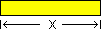
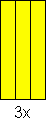
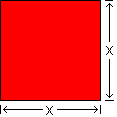
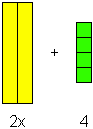
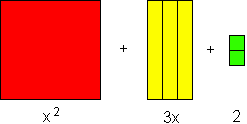
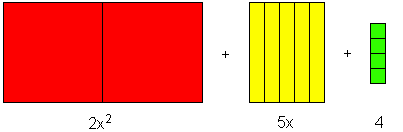
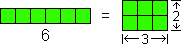
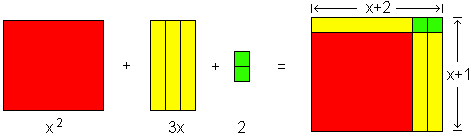
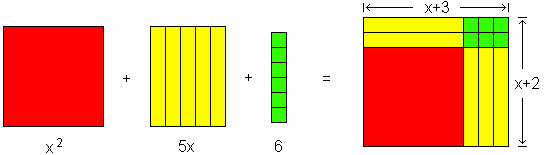
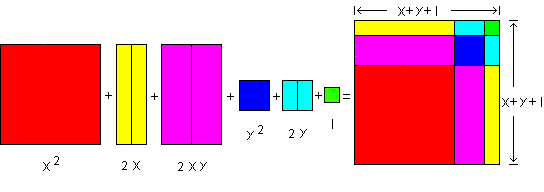
ÿþ<!doctype html public "-//w3c//dtd html 4.0 transitional//en"> <html> <head> <meta http-equiv="Content-Type" content="text/html; charset=iso-8859-1"> <meta name="GENERATOR" content="Mozilla/4.51 [en] (Win98; U) [Netscape]"> <meta name="Author" content="Katherine E. Macedon"> <meta name="Description" content="An illustration of how children form algebraic concepts through manipulation of concrete objects."> <meta name="KeyWords" content="mathematics, algebra, Montessori, epistemology, metamathematics, metalanguage, metalinguistics, quad, semantics, syntax, logic"> <title>ALGEBRA - Mathematical abstraction from concrete experience</title> <STYLE type="text/css"> p {text-align: justify; margin-right: 3%; margin-left: 3%; text-indent: 5%;} </STYLE> </head> <body text="#000000" bgcolor="#FFFFFF" link="#0000EE" vlink="#551A8B" alink="#FF0000"> <center> <h2> &nbsp;<br> <font face="Times New Roman,Times"><font color="#00C000"><font size=+3>ALGEBRA</font></font></font></h2></center> <center> <h2> <font face="Times New Roman,Times"><font color="#0000C0">2 dimensions</font>, <font color="#C00000">base x</font></font></h2></center> <P><font face="Times New Roman,Times">Algebra involves the study of numbers in terms of their functions and relations.&nbsp; In <i>mathematics</i>, a <a href="../UnderCon/UnderCon.htm">formal language</a>, we use numerals to represent known or specified numbers, and letters to represent unknown or unspecified numbers. </font> <p><font face="Times New Roman,Times">In <i>English</i>, a <a href="../UnderCon/UnderCon.htm">natural language</a>, we use names or proper nouns to represent known or specific individuals, and pronouns to represent unknown or unspecified individuals.&nbsp; The Montessori student learns proper use of the English language while interacting with physical <i>objects</i> represented by the proper nouns and pronouns of English, <i>not</i> by employing some other natural language as a metalanguage in which to discuss the English language.&nbsp; (It is generally poor practice to use a natural language, which the student has substantially mastered, as a metalanguage in which to study a second natural language. Such practice usually results in the student translating expressions from the second language into the first language for processing, rather than learning to think and speak fluently in the second language.&nbsp; A similar practice, using English as a metalanguage in which to study the language of mathematics, is even more costly to the student.) </font> <p><font face="Times New Roman,Times">The following is an explanation of how the student learns algebra while interacting with manipulatives, physical <i>objects,</i> represented by the numerals and variables of mathematics.&nbsp; For simplicity here, the explanation is given in two dimensions.&nbsp; Of course, the youngest students interact with perceptual three-dimensional objects, concrete rectangular prisims, rather than with imaginary two-dimensional objects, abstract rectangles. </font> <font face="Times New Roman,Times">&nbsp; </font> <center><img SRC="rainbow.gif" ALT="Spectrum" VSPACE=3 height=3 width=94%></center> <br> <blockquote><b><font face="Times New Roman,Times">1.&nbsp;&nbsp;&nbsp; The proper interpretation of a numeral by answering three questions:</font></b> <ul> <li> <b><font face="Times New Roman,Times"><font color="#00C000">How many objects?</font></font></b></li> <li> <b><font face="Times New Roman,Times"><font color="#C00000">What base?</font></font></b></li> <li> <b><font face="Times New Roman,Times"><font color="#0000C0">In how many dimensions?</font></font></b></li> </ul> <br><a NAME="*1"></a><font face="Times New Roman,Times">Here we have a unit square, it is one unit in two dimensions, in width and in length.&nbsp; We use numerals to name specific numbers in mathematics (just as we use proper names to name specific objects in English). *<sup>1 <a href="#*1 N.B.">N.B.</a></sup></font>&nbsp;<font face="Times New Roman,Times">&nbsp; We can name this object  one unit-square ,  (1 &times; 1<sup>2</sup>) ,  one unit , or simply  1 .</font> <br><font face="Times New Roman,Times">&nbsp;</font> <br><font face="Times New Roman,Times">&nbsp;</font><img SRC="unit.gif" > <br><font face="Times New Roman,Times">&nbsp;</font> <br><font face="Times New Roman,Times">How many? ... <b><font color="#00CC00">1</font></b>.&nbsp;&nbsp;&nbsp;&nbsp; What base? ... <b><font color="#C00000">1</font></b>.&nbsp;&nbsp;&nbsp;&nbsp; In how many dimensions? ... <b><font color="#0000C0">2</font></b>.&nbsp;&nbsp;&nbsp;&nbsp;&nbsp;&nbsp;&nbsp;&nbsp;&nbsp;<b> (<font color="#00CC00">1</font> &times; <font color="#C00000">1</font><sup><font color="#0000C0">2</font></sup>) = 1</b></font> <br><font face="Times New Roman,Times">&nbsp;</font> <br><font face="Times New Roman,Times">&nbsp;</font> <br><font face="Times New Roman,Times">Here we have five unit-squares.&nbsp; We can name these objects  five unit-squares ,  (5 &times; 1<sup>2</sup>) ,  five units , or simply  5 .&nbsp; Alternatively, we have one bar consisting of five unit-squares, <i>i.e.</i>, a bar five units in width and one unit in length.&nbsp; Thus, we can name this object  one five-one-way ,  (1 &times; 5<sup>1</sup>) ,  one five-bar , or simply  5 .</font> <br><font face="Times New Roman,Times">&nbsp;</font> <br><font face="Times New Roman,Times">&nbsp;</font><img SRC="5units.gif" height=16 width=76> <br><font face="Times New Roman,Times">&nbsp;</font> <br><font face="Times New Roman,Times">How many? ... <b><font color="#00C000">5</font></b>.&nbsp;&nbsp;&nbsp;&nbsp; What base? ... <b><font color="#CC0000">1</font></b>.&nbsp;&nbsp;&nbsp;&nbsp; In how many dimensions? ... <b><font color="#0000C0">2</font></b>.&nbsp;&nbsp;&nbsp;&nbsp;&nbsp;&nbsp;&nbsp;&nbsp;&nbsp; <b>(<font color="#00CC00">5</font> &times;</b></font><b> <font color="#CC0000">1</font><sup><font color="#0000C0">2</font></sup>) = 5</b> <br><font face="Times New Roman,Times">How many? ... <b><font color="#00C000">1</font></b>.&nbsp;&nbsp;&nbsp;&nbsp; What base?&nbsp;&nbsp;&nbsp;&nbsp; <b><font color="#CC0000">5</font></b>.&nbsp;&nbsp;&nbsp;&nbsp; In how many dimensions? ... <b><font color="#0000C0">1</font></b>.&nbsp;&nbsp;&nbsp;&nbsp;&nbsp;&nbsp;&nbsp;&nbsp;&nbsp; <b>(<font color="#00CC00">1</font></b></font><b> &times; <font color="#CC0000">5</font><sup><font color="#0000C0">1</font></sup>) = 5</b> <br><font face="Times New Roman,Times">&nbsp;</font> <br><font face="Times New Roman,Times">&nbsp;</font> <br><font face="Times New Roman,Times">Here we have another bar.&nbsp; It is one unit in length, but its width is not divided into units, so it doesn't have a specified width.&nbsp; Since the name of the width does not represent a specified number, the interpretation or value given to that name may change or vary; so that name is a variable.&nbsp; We use variables to name unspecified numbers in mathematics (just as we use pronouns to name unspecified objects in English).&nbsp; We use letters as variables in mathematics.&nbsp; We name the width of this object  x because we can't count it as any specific number of units.&nbsp; Thus, we have a bar x units in width and one unit in length.&nbsp; We name this object  one x-one-way ,  (1 &times; x<sup>1</sup>) ,  one x-bar , or simply  x .</font> <br><font face="Times New Roman,Times">&nbsp;</font> <br>&nbsp;<img SRC="x.gif" height=30 width=102> <br><font face="Times New Roman,Times">&nbsp;</font> <br><font face="Times New Roman,Times">How many? ... <b><font color="#00CC00">1</font></b>.&nbsp;&nbsp;&nbsp;&nbsp; What base? ... <b><font color="#CC0000">x</font></b>.</font>&nbsp;&nbsp;&nbsp;&nbsp; In how many dimensions? ... <b><font color="#0000C0">1</font></b>.&nbsp;&nbsp;&nbsp;&nbsp;&nbsp;&nbsp;&nbsp;<b> (<font color="#00CC00">1</font> &times; <font color="#CC0000">x</font><sup><font color="#0000C0">1</font></sup>) = x</b> <br><font face="Times New Roman,Times">&nbsp;</font> <br><font face="Times New Roman,Times">&nbsp;</font> <br><font face="Times New Roman,Times">We can now regard our unit square as a bar, in <i>base x</i>, that measures x in no (zero) dimensions.&nbsp; We can now name this object  one x-no-way ,  (1 &times; x<sup>0</sup>) ,  one unit , or simply  1 .</font> <br><font face="Times New Roman,Times">&nbsp;</font> <br><font face="Times New Roman,Times">&nbsp;</font><img SRC="unit.gif" > <br><font face="Times New Roman,Times">&nbsp;</font> <br><font face="Times New Roman,Times">How many? ... <b><font color="#00CC00">1</font></b>.&nbsp;&nbsp;&nbsp;&nbsp; What base? ... <b><font color="#CC0000">x</font></b>.&nbsp;&nbsp;&nbsp;&nbsp; In how many dimensions? ... <b><font color="#0000C0">0</font></b>.&nbsp;&nbsp;&nbsp;&nbsp;&nbsp;&nbsp;&nbsp;<b> (<font color="#00C000">1</font> &times; <font color="#CC0000">x</font><sup><font color="#0000C0">0</font></sup>) = 1</b></font> <br><font face="Times New Roman,Times">&nbsp;</font> <br><font face="Times New Roman,Times">&nbsp;</font> <br><font face="Times New Roman,Times">Likewise, we can rename this object, in <i>base x</i>, as  five x-no-way ,  (5 &times; x<sup>0</sup>) ,  five units , or simply  5 .</font> <br><font face="Times New Roman,Times">&nbsp;</font> <br><font face="Times New Roman,Times">&nbsp;</font><img SRC="5units.gif" height=16 width=76> <br><font face="Times New Roman,Times">&nbsp;</font> <br><font face="Times New Roman,Times">How many? ... <b><font color="#00C000">5</font></b>.&nbsp;&nbsp;&nbsp;&nbsp; What base? ... <b><font color="#CC0000">x</font></b>.&nbsp;&nbsp;&nbsp;&nbsp; In how many dimensions? ... <b><font color="#0000C0">0</font></b>.&nbsp;&nbsp;&nbsp;&nbsp;&nbsp;&nbsp;&nbsp; <b>(<font color="#00CC00">5</font> &times;</b></font><b> <font color="#CC0000">x</font><sup><font color="#0000C0">0</font></sup>) = 5</b> <br><font face="Times New Roman,Times">&nbsp;</font> <br><font face="Times New Roman,Times">&nbsp;</font> <br><font face="Times New Roman,Times">Here we have three bars in <i>base x</i>.&nbsp; We name this object&nbsp;  three x-one-way ,  (3 &times; x<sup>1</sup>) ,  three x-bars , or simply  3x .</font> <br><font face="Times New Roman,Times">&nbsp;</font> <br><font face="Times New Roman,Times">&nbsp;</font><img SRC="3x.gif" height=120 width=46> <br><font face="Times New Roman,Times">&nbsp;</font> <br><font face="Times New Roman,Times">How many? ... <b><font color="#00CC00">3</font></b>.&nbsp;&nbsp;&nbsp;&nbsp; What base? ... <b><font color="#C00000">x</font></b>.&nbsp;&nbsp;&nbsp;&nbsp; In how many dimensions? ... <b><font color="#0000C0">1</font></b>.&nbsp;&nbsp;&nbsp;&nbsp;&nbsp;&nbsp;&nbsp; <b>(<font color="#00CC00">3</font> &times; <font color="#C00000">x</font><sup><font color="#0000C0">1</font></sup>) = 3x</b></font> <br><font face="Times New Roman,Times">&nbsp;</font> <br><font face="Times New Roman,Times">&nbsp;</font> <br><font face="Times New Roman,Times">We can arrange nine units in two dimensions so that we have a rectangle that is three wide and three long, or a square.&nbsp; We name this object  three-units squared ,  (3 &times; 3) ,  one three-two-ways ,  (1 &times; 3<sup>2</sup>) ,  one three-square , or simply  3<sup>2</sup> .</font> <br><font face="Times New Roman,Times">&nbsp;</font> <br><font face="Times New Roman,Times">&nbsp;</font><img SRC="3sq.gif" height=59 width=59> <br><font face="Times New Roman,Times">&nbsp;</font> <br><font face="Times New Roman,Times">How many? ... <b><font color="#00CC00">1</font></b>.&nbsp;&nbsp;&nbsp;&nbsp; What base? ... <b><font color="#C00000">3</font></b>.&nbsp;&nbsp;&nbsp;&nbsp; In how many dimensions? ... <b><font color="#0000C0">2</font></b>.&nbsp;&nbsp;&nbsp;&nbsp;&nbsp;&nbsp;&nbsp; <b>(<font color="#00CC00">1</font> &times; <font color="#CC0000">3</font><sup><font color="#0000C0">2</font></sup>) = 3<sup>2</sup></b></font> <br><font face="Times New Roman,Times">&nbsp;</font> <br><font face="Times New Roman,Times">&nbsp;</font> <br><font face="Times New Roman,Times">Here we have a rectangle that is x wide and x long.&nbsp; It is x in two dimensions, and we name it  x-squared ,  (x &times; x) ,  one x-two-ways ,  (1 &times; x<sup>2</sup>) ,  one x-square , or simply  x<sup>2</sup> .</font> <br><font face="Times New Roman,Times">&nbsp;</font> <br><font face="Times New Roman,Times">&nbsp;</font><img SRC="xsquare.gif" height=117 width=117> <br><font face="Times New Roman,Times">&nbsp;</font> <br><font face="Times New Roman,Times">How many? ... <b><font color="#00CC00">1</font></b>.&nbsp;&nbsp;&nbsp;&nbsp; What base? ... <b><font color="#CC0000">x</font></b>.&nbsp;&nbsp;&nbsp;&nbsp; In how many dimensions? ... <b><font color="#0000C0">2</font></b>.&nbsp;&nbsp;&nbsp;&nbsp;&nbsp;&nbsp;&nbsp; <b>(<font color="#00CC00">1</font> &times; <font color="#CC0000">x</font><sup><font color="#0000C0">2</font></sup>) = x<sup>2</sup></b></font> <br><font face="Times New Roman,Times">&nbsp;</font> <br><font face="Times New Roman,Times">&nbsp;</font> <br><font face="Times New Roman,Times">&nbsp;</font> <br><b><font face="Times New Roman,Times">2.&nbsp;&nbsp;&nbsp; The construction of compound (polynomial) numbers, and the composition of compound numerals (polynomials):</font></b> <br><font face="Times New Roman,Times">&nbsp;</font> <br><font face="Times New Roman,Times">&nbsp;</font> <br><font face="Times New Roman,Times">&nbsp;</font><font face="Times New Roman,Times">Here is two x-bars plus four units, named  (2x + 4) :</font> <br><font face="Times New Roman,Times">&nbsp;</font> <br><font face="Times New Roman,Times">&nbsp;</font><img SRC="2xplus4.gif" height=129 width=93> <br><font face="Times New Roman,Times">&nbsp;</font> <br><font face="Times New Roman,Times">&nbsp;</font>How many? ... <b>(<font color="#00CC00">2</font>,<font color="#00CC00"> 4</font>)</b>.&nbsp;&nbsp;&nbsp;&nbsp; What base? ... <b><font color="#CC0000">x</font></b>.&nbsp;&nbsp;&nbsp;&nbsp; In how many dimensions? ... <b>(<font color="#0000C0">1</font>, <font color="#0000C0">0</font>)</b>. <br><font face="Times New Roman,Times">&nbsp;</font> <br><b><font face="Times New Roman,Times">(<font color="#00CC00">2</font><font color="#CC0000">x</font><sup><font color="#0000C0">1</font></sup> + <font color="#00CC00">4</font><font color="#CC0000">x</font><sup><font color="#0000C0">0</font></sup>) = (2x + 4)</font></b><font face="Times New Roman,Times"></font> <br>&nbsp; <br><font face="Times New Roman,Times">&nbsp;</font> <br><font face="Times New Roman,Times">Here is one x-square plus three x-bars plus two units,&nbsp; written  (x<sup>2</sup> + 3x + 2) :</font> <br><font face="Times New Roman,Times">&nbsp;</font> <br><font face="Times New Roman,Times">&nbsp;</font><img SRC="xsq3x2.gif" height=124 width=247> <br><font face="Times New Roman,Times">&nbsp;</font> <br>How many? ... <b>(<font color="#00CC00">1</font>, <font color="#00C000">3</font>, <font color="#00CC00">2</font>)</b><font face="Times New Roman,Times">.&nbsp;&nbsp;&nbsp;&nbsp; What base? ... <b><font color="#CC0000">x</font></b>.&nbsp;&nbsp;&nbsp;&nbsp; In how many dimensions? ... <b>(<font color="#0000C0">2</font>, <font color="#0000C0">1</font>, <font color="#0000C0">0</font>)</b>.</font> <br><font face="Times New Roman,Times">&nbsp;</font> <br><b><font face="Times New Roman,Times">(<font color="#00CC00">1</font><font color="#CC0000">x</font><sup><font color="#0000C0">2</font></sup> + <font color="#00CC00">3</font><font color="#CC0000">x</font><sup><font color="#0000C0">1</font></sup> + <font color="#00CC00">2</font><font color="#CC0000">x</font><sup><font color="#0000C0">0</font></sup> )</font></b> <b>= (x<sup>2</sup> + 3x + 2)</b> <br>&nbsp; <br><font face="Times New Roman,Times">&nbsp;</font> <br><font face="Times New Roman,Times">Here is two x-squares plus five x-bars plus four units, which we name  (2x<sup>2 </sup>+ 5x + 4) :</font> <br><font face="Times New Roman,Times">&nbsp;</font> <br><font face="Times New Roman,Times">&nbsp;</font><img SRC="2xsq5x4.gif" height=132 width=402> <br><font face="Times New Roman,Times">&nbsp;</font> <br>How many? ... <b>(<font color="#00CC00">2</font>, <font color="#00CC00">5</font>, <font color="#00CC00">4</font>)</b><font face="Times New Roman,Times">.&nbsp;&nbsp;&nbsp;&nbsp; What base? ... <b><font color="#CC0000">x</font></b>.&nbsp;&nbsp;&nbsp;&nbsp; In how many dimensions? ... <b>(<font color="#0000C0">2</font>, <font color="#0000C0">1</font>, <font color="#0000C0">0</font>)</b>.</font> <br><font face="Times New Roman,Times">&nbsp;</font> <br><b><font face="Times New Roman,Times">(<font color="#00CC00">2</font><font color="#C00000">x</font><sup><font color="#0000C0">2</font></sup> + <font color="#00CC00">5</font><font color="#CC0000">x</font><sup><font color="#0000C0">1</font></sup> + <font color="#00CC00">4</font><font color="#CC0000">x</font><sup><font color="#0000C0">0</font></sup>)</font></b> <b>= (2x<sup>2</sup> + 5x + 4)</b> <br><font face="Times New Roman,Times">&nbsp;</font> <br><font face="Times New Roman,Times">&nbsp;</font> <br><font face="Times New Roman,Times">&nbsp;</font> <br><b><font face="Times New Roman,Times">3.&nbsp;&nbsp;&nbsp; The factoring of polynomial numbers:</font></b> <br>&nbsp; <br><font face="Times New Roman,Times">&nbsp;</font> <br><a NAME="*2"></a><font face="Times New Roman,Times">In arithmetic and algebra we often need to find the factors of a number to solve a problem.&nbsp; The factors of a number are two or more numbers which, multiplied together, <i>are</i> that number.&nbsp; For example, 3 and 2 are factors of 6, because 3 times 2 <i>is</i> 6.&nbsp;</font> *<sup>2</sup> <sup><a href="#*2 N.B.">N.B.</a></sup> <br><font face="Times New Roman,Times">&nbsp;</font> <br><font face="Times New Roman,Times">Using manipulatives we can find the factors of a number by reconstructing a bar of unit squares into a rectangle of unit squares.&nbsp; Here are the factors of 6:</font> <br><font face="Times New Roman,Times">&nbsp;</font> <br><font face="Times New Roman,Times">&nbsp;</font><img SRC="factors6.gif" height=44 width=181> <br><font face="Times New Roman,Times">&nbsp;</font> <br><font face="Times New Roman,Times">We can represent this fact with the expression,  <b>6 = (3 &times; 2)</b> .</font> <br><font face="Times New Roman,Times">&nbsp;</font> <br><font face="Times New Roman,Times">&nbsp;</font> <br><font face="Times New Roman,Times">Since the trinomial  (x<sup>2</sup> + 3x + 2) names a compound number constructed of three groups of rectangular parts, we can find the factors of this number by reconstructing the rectangular parts into a single rectangle.&nbsp; The factors are the resulting rectangle's width and length, (x + 2) and (x + 1).</font> <br><font face="Times New Roman,Times">&nbsp;</font> <br><font face="Times New Roman,Times">&nbsp;</font><img SRC="factorx2.gif" height=136 width=471> <br><font face="Times New Roman,Times">&nbsp;</font> <br><font face="Times New Roman,Times">To represent this fact we write  <b>(x<sup>2</sup> + 3x + 2) = (x + 2) (x + 1)</b> .</font> <br>&nbsp; <br><font face="Times New Roman,Times">&nbsp;</font> <br><font face="Times New Roman,Times">Let's factor the number, (x<sup>2</sup> + 5x + 6).&nbsp; First we group the blocks so that each group is represented by a part of the trinomial.&nbsp; Then we reconstruct this row of grouped blocks into a single rectangle, and find the width and length of the rectangle, which are the factors of the number.</font> <br><font face="Times New Roman,Times">&nbsp;</font> <br><font face="Times New Roman,Times">&nbsp;</font><img SRC="factorx6.gif" height=155 width=544> <br><font face="Times New Roman,Times">&nbsp;</font> <br><font face="Times New Roman,Times">The sentence that represents this fact is  <b>(x<sup>2</sup> + 5x + 6) = (x + 3) (x + 2)</b> </font>. <br>&nbsp; <br>&nbsp; <br><font face="Times New Roman,Times">&nbsp;</font> <br><b><font face="Times New Roman,Times">4.&nbsp;&nbsp;&nbsp; Higher dimensions and definite bases:</font></b> <br><b><font face="Times New Roman,Times">&nbsp;</font></b> <br><font face="Times New Roman,Times">&nbsp;</font> <br><font face="Times New Roman,Times">After the Montessori student learns to factor polynomial numbers and perform basic operations in two dimensions, such as addition, subtraction, multiplication, division, and square roots, using manipulatives, he may then use three-dimensional blocks, in base x, to perform basic operations, such as addition, subtraction, multiplication, division, and cube roots.</font> <br><font face="Times New Roman,Times">&nbsp;</font> <br><font face="Times New Roman,Times">Having mastered these algebraic manipulations and notations, the student may substitute a definite base (such as base ten) for base x.&nbsp; He then discovers how to perform these same operations using multidigit, composed numerals, in a number system incorporating place value to facilitate working with large numbers.&nbsp; Such a student does not require  lessons or  demonstrations of traditional Montessori math equipment.&nbsp; He <i>discovers</i> for himself how to do long division or how to calculate a square root.</font> <br><font face="Times New Roman,Times">&nbsp;</font> <br><font face="Times New Roman,Times">The joys of such discoveries are even available to primary-level students who have not yet acquired the perceptual ability to distinguish a numeral  2 from a numeral  5 , or a numeral  6 from a numeral  9 .&nbsp; Such students can master basic operations, such as long division and square roots, using only the digits ( 0  1  2  3 ) of the <i>base-quad</i> number system, <i>before</i> they can reliably decode the ten digits ( 0  1  2  3  4  5  6  7  8  9 ) required to operate in the <i>base-ten</i> number system.&nbsp; By having their learning environments enriched with <a href="../UnderCon/UnderCon.htm">base-quad </a>Montessori math materials, students will not be prevented by limitations of traditional, base-ten materials from developing mathematical aptitudes during earlier and more fruitful  sensitive periods for the acquisition of those aptitudes.</font> <br>&nbsp; <br>&nbsp; <br><font face="Times New Roman,Times">&nbsp;</font> <br><b><font face="Times New Roman,Times">5.&nbsp;&nbsp;&nbsp; Multiple bases  &nbsp; working with more than one variable:</font></b> <br><b><font face="Times New Roman,Times">&nbsp;</font></b> <br><font face="Times New Roman,Times">&nbsp;</font> <br><font face="Times New Roman,Times">As the student employs this knowledge of algebraic operations using expressions with a single variable to the task of mastering arithmetic, he also extends his study of algebra to numbers incorporating several variables.&nbsp; To build these numbers he requires additional blocks with distinct lengths and widths representing additional unspecified numbers (y, z, etc.) which may vary in value from both x and 1.</font> <br><font face="Times New Roman,Times">&nbsp;</font> <br><font face="Times New Roman,Times">&nbsp;</font> <br><font face="Times New Roman,Times">Now let's factor the number (x<sup>2</sup> + 2x + 2xy + y<sup>2 </sup>+ 2y + 1).&nbsp; First construct the blocks into groups, each of which is represented by a part of the polynomial.&nbsp; Then we reconstruct the row of grouped blocks into a rectangle, and find the width and length of the rectangle, which are the factors of the number.&nbsp; In this case we get a square, bearing an unmistakable similarity to the face of the trinomial cube found in many Montessori classrooms.</font> <br><font face="Times New Roman,Times">&nbsp;</font> <br><font face="Times New Roman,Times">&nbsp;</font><img SRC="factxy.GIF" height=192 width=544> <br><font face="Times New Roman,Times">The sentence that specifies this fact is  <b>(x<sup>2</sup> + 2x + 2xy + y<sup>2 </sup>+ 2y + 1) = (x + y + 1)<sup>2</sup></b> .</font> <br>&nbsp; <br><font face="Times New Roman,Times">&nbsp;</font> <center><img SRC="rainbow.gif" ALT="Spectrum" VSPACE=3 height=3 width=100%></center> <a NAME="*1 N.B."></a>*<sup>1</sup>&nbsp; <a href="#*1">N.B.</a>: <br><font face="Times New Roman,Times">&nbsp;</font> <br>In order to derive the maximum benefit from interaction with a specially prepared Montessori environment,&nbsp; it is crucial that the student not confuse the concept of <b>a numeral   a name of a number </b> (which is a <i>word</i> from the language of mathematical discourse), with the concept of <b>a number   a quantity or measure </b> (which is an <i>object</i> from the universe of mathematical discourse). <blockquote><font size=-1><i>Confusion of word with object</i> is a more serious problem for the young student of mathematics than for the young student of English.&nbsp; Despite our imprecise usage of English, the student is not very apt to confuse a tree, which he can learn to climb, with  tree , which he can learn to pronounce, spell, write, and read.&nbsp; If we mistakenly ask him to put mom on the blackboard, he will probably reach for the chalk rather than reach for his mother, but we had better not ask him to put paint on the blackboard unless we are prepared to learn an expensive, albeit valuable and well deserved, lesson!&nbsp; However, he is more apt to confuse 1 and 2, from which he can construct 3, with  1 and  2 , from which he can compose  21 or  12 .&nbsp; (He may learn to avoid this latter confusion by unconscious attention to context, but even world-renowned mathematicians have been known to confuse a material conditional with an implication.)</font></blockquote> When working with a very young mathematician, who has not yet developed the level of auditory discrimination necessary to reliably distinguish between the sounds of&nbsp; the spoken words  number and  numeral , it is preferable to use language which will not contribute to the student's confusion: <br><font face="Times New Roman,Times">&nbsp; <br>&nbsp;&nbsp;&nbsp;&nbsp;&nbsp;&nbsp;&nbsp; Vocalize the expression  construct (x + 2) as  <b>construct the <i>number</i>, x plus two</b> .</font> <br><font face="Times New Roman,Times">&nbsp; <br>&nbsp;&nbsp;&nbsp;&nbsp;&nbsp;&nbsp;&nbsp; Vocalize the expression  compose  (x + 2)  as  <b>compose the <i>name of</i>&nbsp; x plus two</b> .</font> <br><font face="Times New Roman,Times">&nbsp; <br>&nbsp;&nbsp;&nbsp;&nbsp;&nbsp;&nbsp;&nbsp; Do <b><i>not</i></b> vocalize  compose  (x + 2)  as  <b>compose the <i>numeral for&nbsp;</i> x plus two</b> . <br>&nbsp; <div align=right><a href="algebra2.htm#*1">[Back to *1 in main text above]</a></div></font> <br><a NAME="*2 N.B."></a><font face="Times New Roman,Times">*<sup>2</sup>&nbsp; <a href="#*2">N.B.</a></font>: <br><font face="Times New Roman,Times">&nbsp; <br>In order to derive the maximum benefit from interaction with a specially prepared Montessori environment,&nbsp; it is crucial that the student not confuse the concept of <b>similarity or equivalence   the same in some respect(s) </b> (which constitutes joint membership in a set or class)  with the concept of <b>identity   the same in all respects </b> (which constitutes being one and the same object). <br><font face="Times New Roman,Times">&nbsp; <br><font face="Times New Roman,Times"> (3 &times; 2) and  6 are two different names (numerals) for the same object (the number 6).&nbsp; These two names are similar names, in that they each name the same object; they are equivalent names, in that they each take the same object as their semantic value.&nbsp; However, they are <i>not</i> identical names.</font> <br><font face="Times New Roman,Times">&nbsp; <br><font face="Times New Roman,Times">We can represent such facts with metamathematical <i>equivalency statements</i> about the numerals (the names) that we use to refer to numbers:</font> <br><font face="Times New Roman,Times">&nbsp; <br><font face="Times New Roman,Times">&nbsp;&nbsp;&nbsp;&nbsp;&nbsp;&nbsp;&nbsp;  <b> (3 &times; 2) <i>names</i> the</b></font><b><font face=""> </font><font face="Times New Roman,Times">same number that  6 <i>names</i></font></b><font face="Times New Roman,Times">  ,</font> <br><font face="Times New Roman,Times">&nbsp; <br><font face="Times New Roman,Times">&nbsp;&nbsp;&nbsp;&nbsp;&nbsp;&nbsp;&nbsp;  <b> (3 &times; 2) is equivalent to  6 </font></b><font face="Times New Roman,Times">  ,</font> <br><font face="Times New Roman,Times">&nbsp; <br><font face="Times New Roman,Times">&nbsp;&nbsp;&nbsp;&nbsp;&nbsp;&nbsp;&nbsp;  <b> (3 &times; 2) a"  6 </font></b><font face="Times New Roman,Times">  ,&nbsp; or</font> <br><font face="Times New Roman,Times">&nbsp; <br><font face="Times New Roman,Times">&nbsp;&nbsp;&nbsp;&nbsp;&nbsp;&nbsp;&nbsp;  <b> (3 &times; 2) <i>equals</i>  6 </b>  .</font> <br><font face="Times New Roman,Times">&nbsp; <br><font face="Times New Roman,Times">Usually, however, we simply represent such facts with mathematical <i>identity statements</i> about the actual numbers (the objects) themselves:</font> <br><font face="Times New Roman,Times">&nbsp; <br><font face="Times New Roman,Times">&nbsp;&nbsp;&nbsp;&nbsp;&nbsp;&nbsp;&nbsp;  <b>(3 &times; 2) <i>is</i> the</b></font><b><font face=""> </font><font face="Times New Roman,Times">same number as 6</font></b><font face="Times New Roman,Times">  ,</font> <br><font face="Times New Roman,Times">&nbsp; <br><font face="Times New Roman,Times">&nbsp;&nbsp;&nbsp;&nbsp;&nbsp;&nbsp;&nbsp;  <b>(3 &times; 2) is identical to 6 </b> ,</font> <br><font face="Times New Roman,Times">&nbsp; <br><font face="Times New Roman,Times">&nbsp;&nbsp;&nbsp;&nbsp;&nbsp;&nbsp;&nbsp;  <b>(3 &times; 2) = 6 </b> ,&nbsp; or</font> <br><font face="Times New Roman,Times">&nbsp; <br><font face="Times New Roman,Times">&nbsp;&nbsp;&nbsp;&nbsp;&nbsp;&nbsp;&nbsp;  <b>(3 &times; 2) <i>is</i> 6 </b> .</font> <br><font face="Times New Roman,Times">&nbsp; <br>Therefore, whenever vocalizing&nbsp; mathematical expressions (identity statements or equations), it is preferable to use language which will not contribute to the student's confusion: <br><font face="Times New Roman,Times">&nbsp; <br>&nbsp;&nbsp;&nbsp;&nbsp;&nbsp;&nbsp;&nbsp; Vocalize the expression  1 + 1 = 2 as  <b>one plus one&nbsp; <i>is&nbsp;</i> two</b> . <br><font face="Times New Roman,Times">&nbsp; <br>&nbsp;&nbsp;&nbsp;&nbsp;&nbsp;&nbsp;&nbsp; Do <b><i>not</i></b> vocalize  1 + 1 = 2 as  <b>one plus one&nbsp; <i>equals&nbsp;</i> two</b> . <br>&nbsp; <div align=right>&nbsp;<a href="algebra2.htm#*2">[Back to *2 in main text above]</a></div> </blockquote> <CENTER><IMG SRC="../../rainbow.gif" ALT="Spectrum" VSPACE=2 HEIGHT=3 WIDTH=94%></CENTER> <font face="Arial,Helvetica"><font size=-1> <CENTER><A HREF="../Environment/environment.html">[BACK]</A></FONT></CENTER> <CENTER><IMG SRC="../../rainbow.gif" ALT="Spectrum" VSPACE=4 HEIGHT=3 WIDTH=94%></CENTER> <CENTER><font face="Arial,Helvetica"><font size=-1>Copyright &copy; 1978 by College of Early Learning.</FONT></FONT></CENTER> &nbsp; </body> </html>